
Real Estate Negotiation 101: The CALMER System
When I started in real estate in 2019, I was thrown into daily negotiations. It wasn’t easy.
My first job in the business was leasing and managing an industrial property in South Ottawa, which meant negotiating with dozens of tough, experienced used car salesmen and mechanics. Great people. Fantastic tenants. But masters of negotiation, and none of them were about to let a new agent from small-town Ontario get the better of them.
I made all the rookie mistakes:
- I asked for too much and pushed good offers away.
- I asked for too little and left money on the table.
- I got emotional when offers came in low or the tactics got tricky.
- I was rigid when I should have been flexible, and flexible when I should have stood firm.
- Most of all, the whole process stressed me out.
What changed
Luckily, I had mentors. I read Jim Camp’s Start with No, still my favourite book on negotiation, and then Getting to Yes, the famous one. The titles contradict each other and the approaches are radically different. It’s worth knowing both. I took the Camp Negotiation course. And most importantly, I practised. Week after week, on live deals, with real money at stake.
Over time I built a system that works. It’s fair, it’s firm, and it’s persuasive without being pushy. It works whether we’re buying or selling, and whether the other side is a bank, a seasoned investor, or a homeowner who just wants to move on.
I call it the CALMER System, because the main thing it does is take the stress out of the process while getting a better result. Six steps. Here they are.
The CALMER System
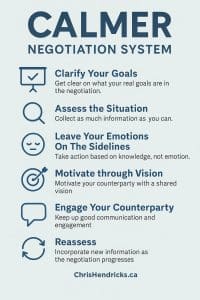
C: Clarify our goals
Before we make an offer or list a home, we get clear on what we’re actually trying to achieve. Price is one part of it. So are the closing date, the conditions we can live with, what stays with the house, and what happens if the deal falls apart. Underneath all of it: what kind of life is this move supposed to set up?
Once we know that, every decision in the negotiation gets easier, because we already know what we’re willing to trade and what we’re not.
A: Assess the situation
Next we do the homework. What the market is doing in that segment right now. The full listing history. The strongest comparable sales. What the other side likely needs, what their options are, and what’s boxing them in. Solid facts mean fewer risky assumptions, and that’s where the edge comes from.
Last year a client of mine was interested in a home originally listed at $3.5 million. It had sat for more than a year and had already been cut to $3.25 million. My client couldn’t justify paying more than $3 million.
I went through the listing history, the best comparables, and the seller’s likely position, and built the case for why the asking price still didn’t hold up. Then we structured an opening offer designed to keep the seller at the table. We opened at $2.25 million. After a long negotiation, my client bought the property for $2.85 million: $400,000 under the reduced asking price and $650,000 under the original list.
No insults. No theatrics. Just a well-supported opening position and a plan for where it was headed.
L: Leave emotions on the sidelines
Negotiation is emotional by nature. Someone is buying or selling their home. So we let the numbers and the process drive the decisions as much as we can.
The practical version of this: before anything goes out, we plan how we’ll respond to the likely scenarios. A lowball. A counter at full asking. A competing offer that shows up at the last minute. When it happens, we already know what we’re doing, so nobody has to make a decision while they’re angry.
Calm is a competitive advantage. The side that stays calm usually gets the better deal.
M: Motivate through vision
Pressure makes people defensive. A clear picture of where they end up gets them moving. So instead of pushing, we work to help the other side see how the deal gets them what they want. That’s how the deal gets done without anyone feeling pushed into it.
E: Engage the other side
Deals get done on trust. We keep the lines open with the other agent and, through them, the other side: prompt replies, straight answers, no games. The more engaged the other party is, the more invested they are in getting to a deal instead of walking away over a detail – and that means a better deal for you.
R: Reassess as we go
New information keeps showing up. The inspection comes back. Another offer lands. The seller’s timeline changes. We have a process for taking that in, checking it against the goals from step one, and adjusting, rather than letting it throw us.
Staying flexible on the details is what lets us stay firm on what matters.
Want to learn more?
If you’re buying or selling in Ottawa in the next 12 months, I’d be happy to show you how the CALMER System would apply to your situation. Text CALMER to 613-614-3376 and I’ll send you a few simple tools you can use on your next deal, no cost and no pressure.
Thinking about selling? Start with a free home evaluation and we’ll work through step one together.
Let’s make your next negotiation calmer, and better.
Best,
Chris Hendricks, J.D.
Real Estate Broker, REALTOR®
ChrisHendricks.ca